
Swasth: Streamlining organic farm trading
Swasth: Streamlining organic farm trading
Swasth: Streamlining organic farm trading
Designing an MVP digital marketplace that helps organic farmers and buyers find each other. With produce verification built into every transaction, buyers can trust the brand "Swasth", not just the organic claim.
Designing an MVP digital marketplace that helps organic farmers and buyers find each other. With produce verification built into every transaction, buyers can trust the brand "Swasth", not just the organic claim.

Role
Role
Solo Product Designer
Solo Product Designer
Team
Team
2 devs & Founder
2 devs & Founder
Status
Status
Pre-Launch
Pre-Launch
Duration
Duration
2024 (6 months)
2024 (6 months)
Estimated Impact (Pre-Launch)
100%
100%
Graded & verified
Every listing checked before publishing
Direct
Direct
Discovery for buyers
Find & trust real organic farmers
~14-24%
More per sale for farmers
Organic premium, net of ~5% fee
~14-24%
More per sale for farmers
Organic premium, net of ~5% fee
Estimated from published Indian organic market figures, not Swasth data. Discoverability directional; 5% commission illustrative. Client sets final pricing.
Estimated from published Indian organic market figures, not Swasth data. Discoverability directional; 5% commission illustrative. Client sets final pricing.
The Problem
The Problem
How can a product make "organic" (an invisible, unverifiable quality) trustworthy enough to buy on, while connecting the farmers who grow it with the buyers looking for it?
How can a product make "organic" (an invisible, unverifiable quality) trustworthy enough to buy on, while connecting the farmers who grow it with the buyers looking for it?
Offline, this market ran on physical inspection, face-to-face bargaining, and years of relationships. None of which software has. The product had to rebuild that trust between strangers & help the two sides find each other. It broke into three product problems:
Offline, this market ran on physical inspection, face-to-face bargaining, and years of relationships. None of which software has. The product had to rebuild that trust between strangers & help the two sides find each other. It broke into three product problems:
Verification
Buyers can't tell real organic from relabelled conventional produce without physical verification.
Buyers can't tell real organic from relabelled conventional produce without physical verification.
Discovery
Buyers have to rely on the middle men for the produce supplies as they can't directly find the farmers.
Buyers have to rely on the middle men for the produce supplies as they can't directly find the farmers.
Fairness
Rural and small scale organic farmers can't reach urban buyers, so have to sell at ordinary rates.
Rural and small scale organic farmers can't reach urban buyers, so have to sell at ordinary rates.
Existing government programs (NPOP, PGS, Jaivik Bharat) build trust top-down through offline licensing, which is slow, costly, and heavily bureaucratic, locking out the smallholders who grow most of India's organic produce.
The open question: could trust instead be built into the transaction, simple enough for an unfamiliar farmer and buyer to both rely on?
Existing government programs (NPOP, PGS, Jaivik Bharat) build trust top-down through offline licensing, which is slow, costly, and heavily bureaucratic, locking out the smallholders who grow most of India's organic produce.
The open question: could trust instead be built into the transaction, simple enough for an unfamiliar farmer and buyer to both rely on?
Process & Approach
Process & Approach
The real work was translating an offline, relationship-based trust system into something two strangers could rely on online. With no research budget, I made client domain knowledge the primary source (through many discovery calls), backed by secondary research and competitor teardowns of existing agri and certification platforms.
The real work was translating an offline, relationship-based trust system into something two strangers could rely on online. With no research budget, I made client domain knowledge the primary source (through many discovery calls), backed by secondary research and competitor teardowns of existing agri and certification platforms.
Constraints that shaped every downstream decision
Solo, end-to-end - research through dev handoff, lean team, capped UI complexity
Solo, end-to-end - research through dev handoff, lean team, capped UI complexity
No research budget - client input + secondary research over field studies
No research budget - client input + secondary research over field studies
No research budget - client input + secondary research over field studies
No digital precedent - interaction model built from first principles
No digital precedent - interaction model built from first principles
No digital precedent - interaction model built from first principles
With these challenges in mind, the North Star of the project was to design a seamless, hassle-free way to connect Organic farmers with buyers, making the process fair and accessible to small-scale traders and farmers, and the primary goal was to design an MVP mobile app to facilitate digital auctions.
With these challenges in mind, the North Star of the project was to design a seamless, hassle-free way to connect Organic farmers with buyers, making the process fair and accessible to small-scale traders and farmers, and the primary goal was to design an MVP mobile app to facilitate digital auctions.
Solution
Solution
Solution
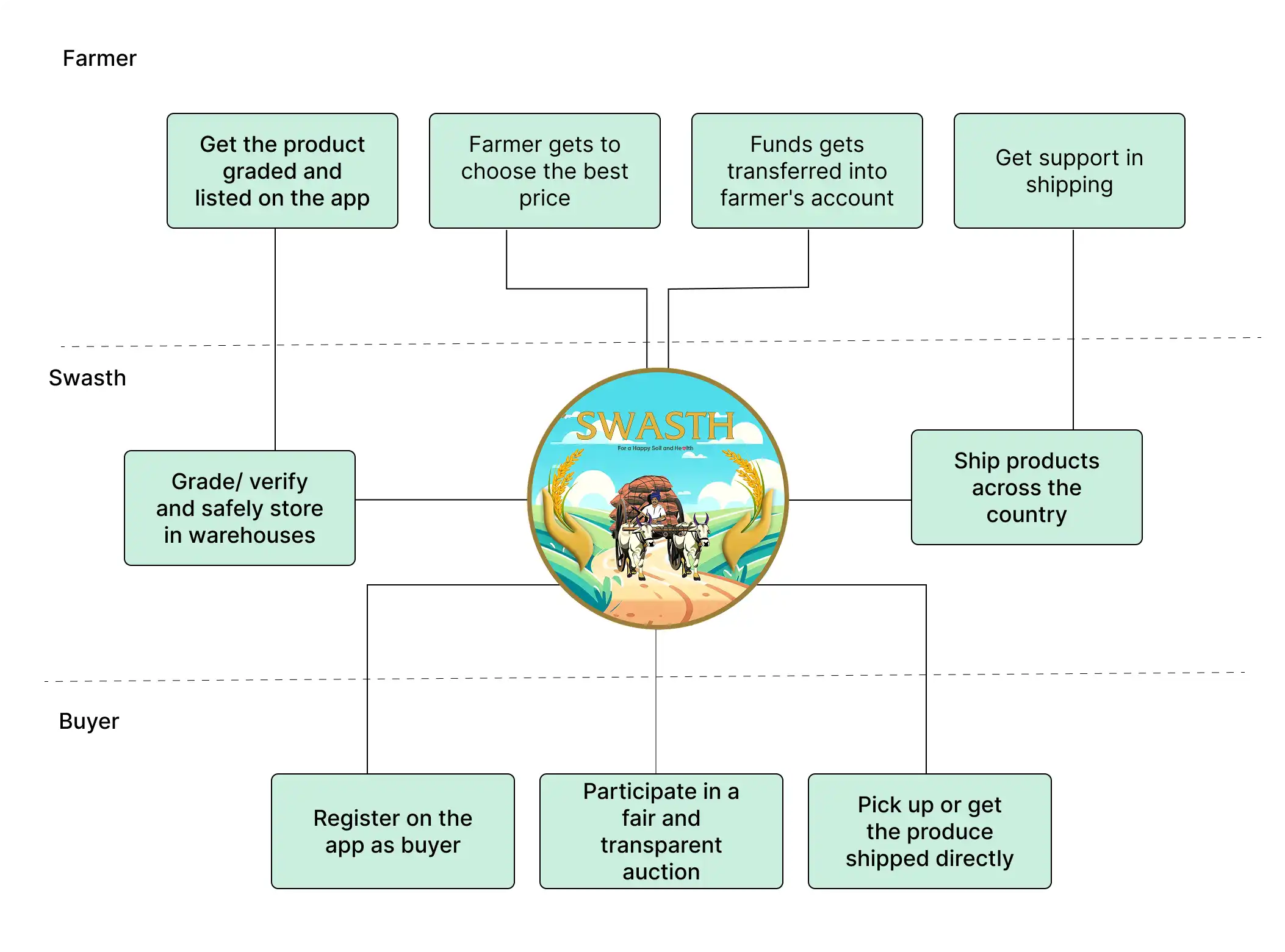
We decided to design three different integrated user profiles within the mobile app to perform different actions based on the user profile selected.
We decided to design three different integrated user profiles within the mobile app to perform different actions based on the user profile selected.
We decided to design three different integrated user profiles within the mobile app to perform different actions based on the user profile selected.
Verification built into the transaction
Three roles, one job: turn an unprovable claim into a trusted, premium-worthy product.

Farmer
Lists organic produce, for the buyers to place live bids.

Buyer
Bids transparently on produce verified as genuinely organic.

Agri-Scientist
Verifies and grades organics so that only produce get listed.
Here is a high level overview of how the various profiles interact with each other:
Here is a high level overview of how the various profiles interact with each other:
Here is a high level overview of how the various profiles interact with each other:
Designing the mobile app
Designing the mobile app
Designing the mobile app
While I can't disclose the nitty-gritties on the research behind the design, the following sections will give an understanding of most important features of the app and the process each profile user performs, along with the branding concepts.
While I can't disclose the nitty-gritties on the research behind the design, the following sections will give an understanding of most important features of the app and the process each profile user performs, along with the branding concepts.
While I can't disclose the nitty-gritties on the research behind the design, the following sections will give an understanding of most important features of the app and the process each profile user performs, along with the branding concepts.
The logo, branding and themes
The logo, branding and themes
Since this is a brand new organization I needed to come up with the logo and the brand guidelines as well.
Since this is a brand new organization I needed to come up with the logo and the brand guidelines as well.
Since this is a brand new organization I needed to come up with the logo and the brand guidelines as well.


Based on the inputs from the client, the logo was designed with the themes of traditionally rooted and agricultural heritage. A medium sea green color palette and artistic illustrations of grain harvest, hands, and a bullock cart create a connection to nature with a grounded aesthetic and traditional farming practices of India. The design reflects a commitment to sustainable and healthy farming, as well as represent the farmer carrying their produce to the market.
Based on the inputs from the client the logo was designed with the themes of rustic charm and agricultural heritage. A medium sea green color palette and artistic illustrations of grains harvest, hands, and a bullock cart create a connection to nature with grounded aesthetic and traditional farming practices of India. The design reflects a commitment to sustainable and healthy farming, as well as represent the farmer carrying their produce to the market.
Based on the inputs from the client the logo was designed with the themes of rustic charm and agricultural heritage. A medium sea green color palette and artistic illustrations of grains harvest, hands, and a bullock cart create a connection to nature with grounded aesthetic and traditional farming practices of India. The design reflects a commitment to sustainable and healthy farming, as well as represent the farmer carrying their produce to the market.
Guiding principles for the design
Guiding principles for the design
• User-Centric: Every aspect of the system must be designed with the end-user in mind, ensuring it’s user-friendly, efficient, and satisfying to use.
• Accessibility: The system should be easily navigable and usable for all, regardless of their ability or disability.
• Inclusive: The system should cater to the needs of diverse users, including farmers with less tech knowledge, merchants/ buyers, and warehouse managers/ graders.
• User-Centric: Every aspect of the system must be designed with the end-user in mind, ensuring it’s user-friendly, efficient, and satisfying to use.
• Accessibility: The system should be easily navigable and usable for all, regardless of their ability or disability.
• Inclusive: The system should cater to the needs of diverse users, including farmers with less tech knowledge, merchants/ buyers, and warehouse managers/ graders.
• User-Centric: Every aspect of the system must be designed with the end-user in mind, ensuring it’s user-friendly, efficient, and satisfying to use.
• Accessibility: The system should be easily navigable and usable for all, regardless of their ability or disability.
• Inclusive: The system should cater to the needs of diverse users, including farmers with less tech knowledge, merchants/ buyers, and warehouse managers/ graders.
Walk-through of the mobile app user flows
Walk-through of the mobile app user flows
If the videos are slow to load Click here to view and interact with the prototype on Figma
If the videos are slow to load Click here to view and interact with the prototype on Figma
If the videos are slow to load Click here to view and interact with the prototype on Figma.
Farmer: verifying and posting a product
User Journey
• Every product in order to be listed on the app should be verified/ graded by an Agri-scientist.
• User has to click on “Submit a product for verification” on the dashboard and enter the product details along with the pictures for verification.
• Upon submitting for verification, the shipping will be handled the staff and the farmer will be notified if further steps are required.
•When grading is completed, the produce will be ready for the farmer to post for auction and upon posting will be visible to the buyers for bidding.
Buyer: Participating in the bidding
User Journey
• The user registers on the app as a buyer and sees a variety of products published for auction.
• User can see the grading details of the product along with the information about the farmer and other info to help the user decide to participate in the auction.
• In order to enter the auction, the user has to enter an amount higher than the current amount shown to enter into the auction bid.
•The buyer who has bided the highest amount of money and is the leading bidder in the auction when the auction time finishes gets automatically picked as the winner and gets an opportunityto buy the product.
Farmer: Selecting the winning bid
User Journey
• Once the product is listed for bidding, it listing will show up in the bids section which can be accessed through the bottom navigation bar.
• User can see various data points related to the auction such as the number of people participating in the auction for different products.
• A default time period of 6 hours is set for the auction and the can be extended if the user wishes.
•The leading bid is selected as winner when the set time is finished and get the right to purchase the produce from the farmer.
Grader: Grading produce
User Journey
• Grader (Agri-scientist) takes the samples from the produce and does the tests to grade the produce.
• The user enters the grade information of the produce and then proceeds to store it in the warehouse till the auction gets finalized.
Grader: Grading produce
User Journey
• User picks the language they are comfortable in using and completes the sign in/up procedures.
• User picks the profile under which they want to register under which is Farmer, Buyer, Grader.
Farmer: verifying and posting a product
Farmer: verifying and posting a product
User Journey
User Journey
• Every product in order to be listed on the app should be verified/ graded by an Agri-scientist.
• Every product in order to be listed on the app should be verified/ graded by an Agri-scientist.
• User has to click on “Submit a product for verification” on the dashboard and enter the product details along with the pictures for verification.
• User has to click on “Submit a product for verification” on the dashboard and enter the product details along with the pictures for verification.
• Upon submitting for verification, the shipping will be handled the staff and the farmer will be notified if further steps are required.
• Upon submitting for verification, the shipping will be handled the staff and the farmer will be notified if further steps are required.
•When grading is completed, the produce will be ready for the farmer to post for auction and upon posting will be visible to the buyers for bidding.
•When grading is completed, the produce will be ready for the farmer to post for auction and upon posting will be visible to the buyers for bidding.
Farmer: Selecting the winning bid
User Journey
User Journey
• Once the product is listed for bidding, it listing will show up in the bids section which can be accessed through the bottom navigation bar.
• Once the product is listed for bidding, it listing will show up in the bids section which can be accessed through the bottom navigation bar.
• User can see various data points related to the auction such as the number of people participating in the auction for different products.
• User can see various data points related to the auction such as the number of people participating in the auction for different products.
• A default time period of 6 hours is set for the auction and the can be extended if the user wishes.
• A default time period of 6 hours is set for the auction and the can be extended if the user wishes.
•The leading bid is selected as winner when the set time is finished and get the right to purchase the produce from the farmer.
•The leading bid is selected as winner when the set time is finished and get the right to purchase the produce from the farmer.
Buyer: Participating in the bidding
User Journey
User Journey
• The user registers on the app as a buyer and sees a variety of products published for auction.
• The user registers on the app as a buyer and sees a variety of products published for auction.
• User can see the grading details of the product along with the information about the farmer and other info to help the user decide to participate in the auction.
• User can see the grading details of the product along with the information about the farmer and other info to help the user decide to participate in the auction.
• In order to enter the auction, the user has to enter an amount higher than the current amount shown to enter into the auction bid.
• In order to enter the auction, the user has to enter an amount higher than the current amount shown to enter into the auction bid.
•The buyer who has bided the highest amount of money and is the leading bidder in the auction when the auction time finishes gets automatically picked as the winner and gets an opportunityto buy the product.
•The buyer who has bided the highest amount of money and is the leading bidder in the auction when the auction time finishes gets automatically picked as the winner and gets an opportunity to buy the product.
Grader: Grading produce
User Journey
User Journey
• Grader (Agri-scientist) takes the samples from the produce and does the tests to grade the produce.
• Grader (Agri-scientist) takes the samples from the produce and does the tests to grade the produce.
• The user enters the grade information of the produce and then proceeds to store it in the warehouse till the auction gets finalized.
• The user enters the grade information of the produce and then proceeds to store it in the warehouse till the auction gets finalized.
On boarding
On boarding
User Journey
User Journey
• User picks the language they are comfortable in using and completes the sign in/up procedures.
• User picks the language they are comfortable in using and completes the sign in/up procedures.
• User picks the profile under which they want to register under which is Farmer, Buyer, Grader.
• User picks the profile under which they want to register under which is Farmer, Buyer, Grader.
From Ambiguity to Clarity
From Ambiguity to Clarity
From Ambiguity to Clarity
In this section I discuss some of the key design decisions and iterations i took in order to make the design more functional and improve the user experience.
In this section I discuss some of the key design decisions and iterations i took in order to make the design more functional and improve the user experience.
In this section I discuss some of the key design decisions and iterations i took in order to make the design more functional and improve the user experience.
The initial drafts were designed based on the inputs given by the client, which were the primary source of information and data behind the design decisions, along with some secondary research and competitive analysis.
The initial drafts were designed based on the inputs given by the client, which were the primary source of information and data behind the design decisions, along with some secondary research and competitive analysis.
Farmer Dashboard - Iterations
Farmer Dashboard - Iterations
Farmer Dashboard - Iterations
After a few rounds of usability testing and stakeholder presentation and gathering inputs, the following changes were made.
After a few rounds of usability testing and stakeholder presentation and gathering inputs, the following changes were made.
After a few rounds of usability testing and stakeholder presentation and gathering inputs, the following changes were made.
Replaced the User Id with actual username to add a bit of personality and personalization to the whole experience.
Consolidated Earning and ratings under a single heading "Insights" and with a cleaner and minimal layout.
Split the actions section into different categories for better clarity and show the user which action must they perform first in-order to start publishing their product by providing a brief description of what each action card does instead of grouping all tasks together which resulted in confusion.
Moved the notifications to the bottom navigation bar and added a help button on top for easy accessibility and visibility.
Replaced the User Id with actual username to add a bit of personality and personalization to the whole experience.
Consolidated Earning and ratings under a single heading "Insights" and with a cleaner and minimal layout.
Split the actions section into different categories for better clarity and show the user which action must they perform first in-order to start publishing their product by providing a brief description of what each action card does instead of grouping all tasks together which resulted in confusion.
Moved the notifications to the bottom navigation bar and added a help button on top for easy accessibility and visibility.
Replaced the User Id with actual username to add a bit of personality and personalization to the whole experience.
Consolidated Earning and ratings under a single heading "Insights" and with a cleaner and minimal layout.
Split the actions section into different categories for better clarity and show the user which action must they perform first in-order to start publishing their product by providing a brief description of what each action card does instead of grouping all tasks together which resulted in confusion.
Moved the notifications to the bottom navigation bar and added a help button on top for easy accessibility and visibility.

Auction flow - Iterations
Auction flow - Iterations
Auction flow - Iterations
Initially, the way to determine the winner of the auction was designed to be completely manual, and the seller had full control over the selcting the winner of the auction, where the seller could see the bids of a particular seller and select whomever they favoured.
However, this way of selecting the winner felt unfair to the other bidders, as they would have no idea when the auction was ending and how much they needed to bid to win the auction.
Initially, the way to determine the winner of the auction was designed to be completely manual, and the seller had full control over the selcting the winner of the auction, where the seller could see the bids of a particular seller and select whomever they favoured.
However, this way of selecting the winner felt unfair to the other bidders, as they would have no idea when the auction was ending and how much they needed to bid to win the auction.
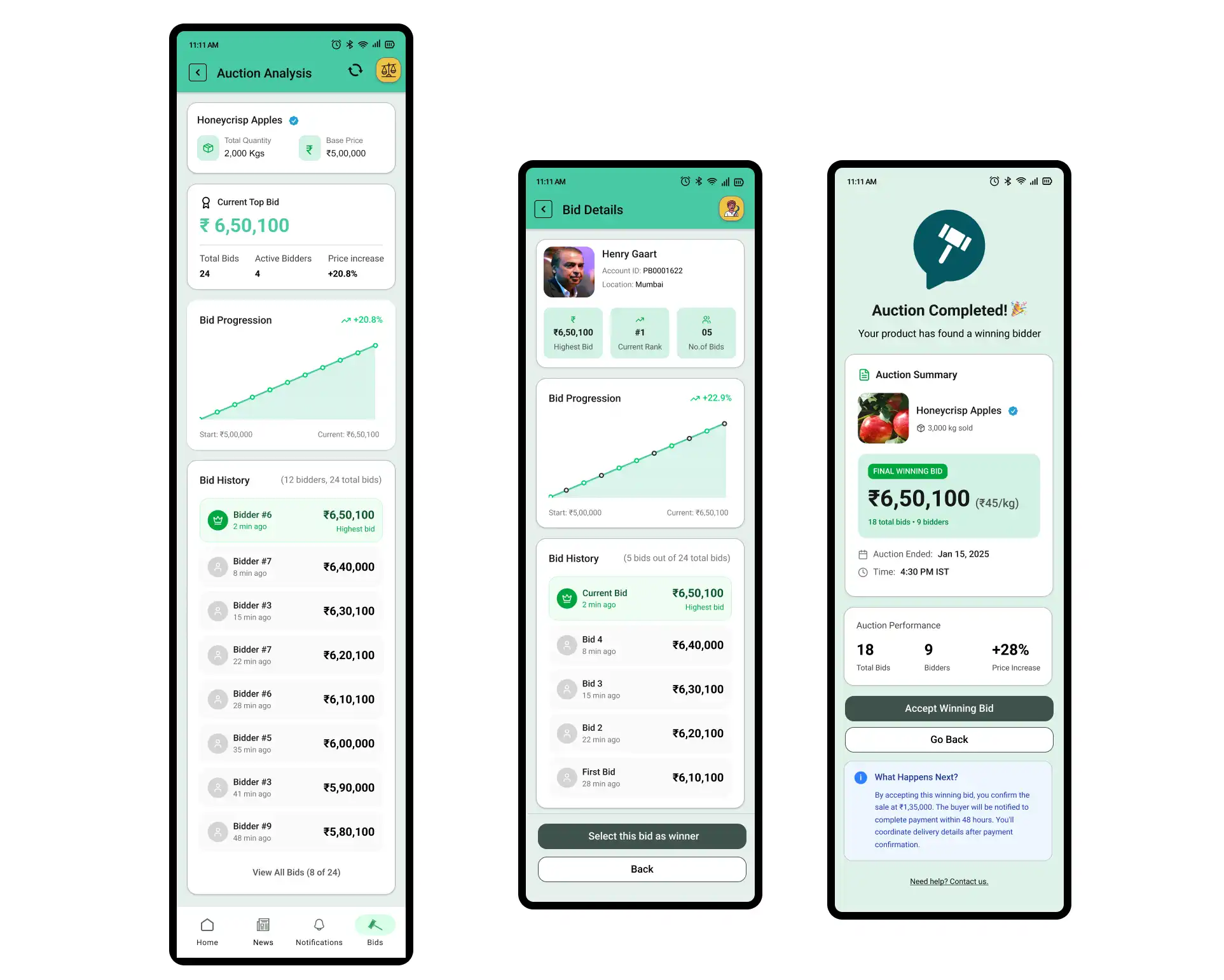
In order to overcome this painpoint, the concept of a timer was designed in such a way that each auction had a limited amount of time, and all the participants in the auction could see how much time was left, and at the end of the timer, the leading bid would win the auction. If the bidding is close and the prices are tight, then the seller can extend the time, or the bidders can request the seller to extend the time if they require.
In order to overcome this painpoint, the concept of a timer was designed in such a way that each auction had a limited amount of time, and all the participants in the auction could see how much time was left, and at the end of the timer, the leading bid would win the auction. If the bidding is close and the prices are tight, then the seller can extend the time, or the bidders can request the seller to extend the time if they require.

Buyer Home screen - Iterations
Buyer Home screen - Iterations
Buyer Home screen - Iterations
A special emphasis is given to the current top bid as it was shown in the initials tests that, the base price and the current top bid are the most important data points while considering to bid on a product.
Redesigned the browse by category menu to be more cohesive and match the other components used in the app.
A special emphasis is given to the current top bid as it was shown in the initials tests that, the base price and the current top bid are the most important data points while considering to bid on a product.
Redesigned the browse by category menu to be more cohesive and match the other components used in the app.
A special emphasis is given to the current top bid as it was shown in the initials tests that, the base price and the current top bid are the most important data points while considering to bid on a product.
Redesigned the browse by category menu to be more cohesive and match the other components used in the app.

Preparing for Dev-Hand-Off
Preparing for Dev-Hand-Off
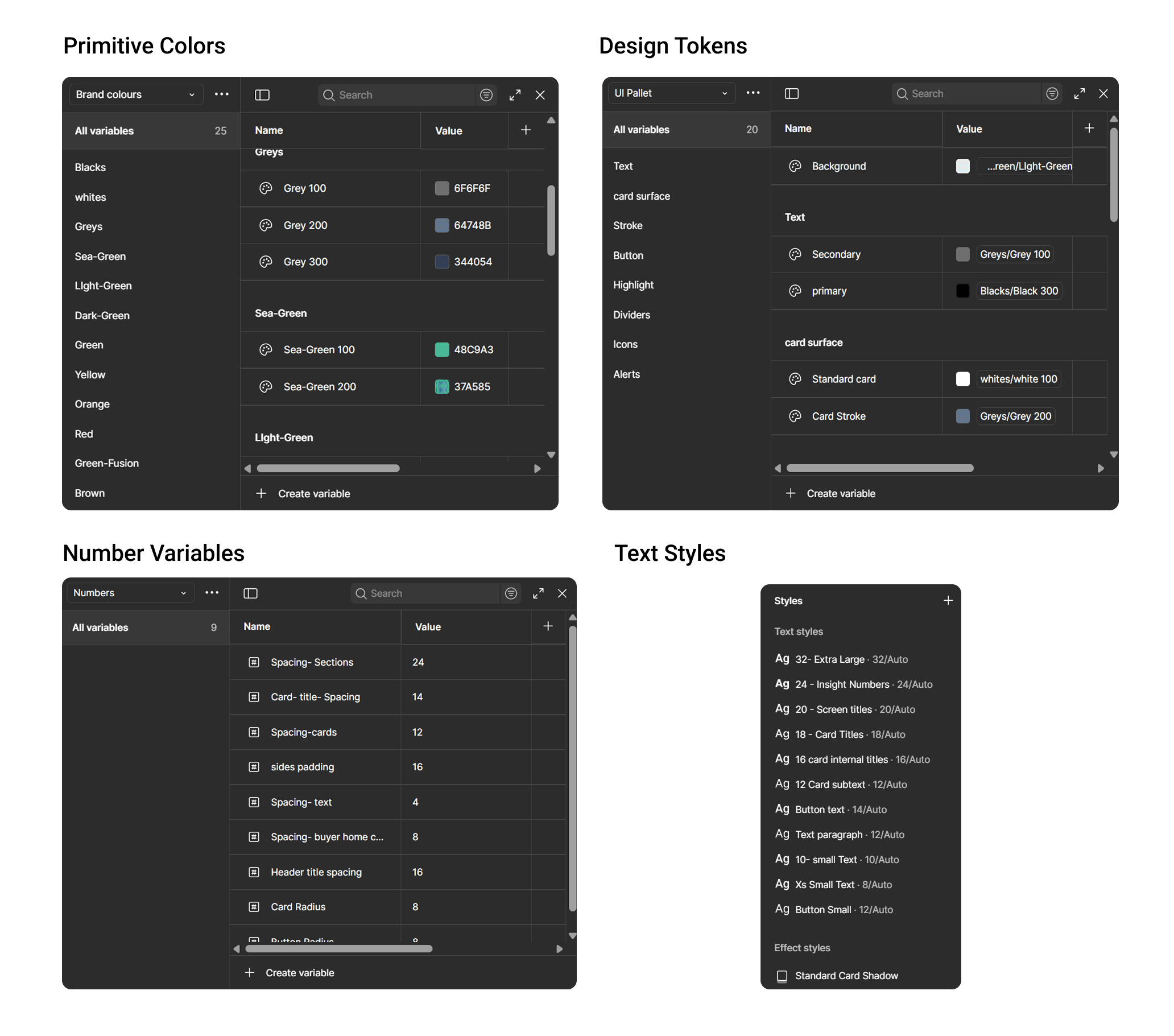
With the final designs approved, my focus shifted to ensuring a seamless developer handoff. I refined component structures in Figma with appropriate properties and set up the design token and variables, along with the styles, to ensure the consistent design language throughout the process. Documented key interactions and states to prevent guesswork during implementation.
With the final designs approved, my focus shifted to ensuring a seamless developer handoff. I refined component structures in Figma with appropriate properties and set up the design token and variables, along with the styles, to ensure the consistent design language throughout the process. Documented key interactions and states to prevent guesswork during implementation.
With the final designs approved, my focus shifted to ensuring a seamless developer handoff. I refined component structures in Figma with appropriate properties and set up the design token and variables, along with the styles, to ensure the consistent design language throughout the process. Documented key interactions and states to prevent guesswork during implementation.
Atoms, Components and properties
Atoms, Components and properties

My Learnings &Takeaways
My Learnings &Takeaways
Through this projects I gained a deep understanding in the dynamic marketplace/ auctions domain as well as agricultural domain and also gained experience in handling a complicated project as a solo designer by undertaking various tasks. As this is project was my first freelance project for a real client, this was a significant step in my career, offering a valuable chance to apply theory in a real world project and transform an offline system into a digital interface.
Through this projects I gained a deep understanding in the dynamic marketplace/ auctions domain as well as agricultural domain and also gained experience in handling a complicated project as a solo designer by undertaking various tasks. As this is project was my first freelance project for a real client, this was a significant step in my career, offering a valuable chance to apply theory in a real world project and transform an offline system into a digital interface.
Through this projects I gained a deep understanding in the dynamic marketplace/ auctions domain as well as agricultural domain and also gained experience in handling a complicated project as a solo designer by undertaking various tasks. As this is project was my first freelance project for a real client, this was a significant step in my career, offering a valuable chance to apply theory in a real world project and transform an offline system into a digital interface.
Further Steps
Further Steps
Since this project is still an early concept and under development and if I had the resources, I'd like to conduct extensive usability tests and conduct user interviews to uncover the pain points in this concept and improve the design to cover those aspects as well.
Since this project is still an early concept and under development and if I had the resources, I'd like to conduct extensive usability tests and conduct user interviews to uncover the pain points in this concept and improve the design to cover those aspects as well.
Since this project is still an early concept and under development and if I had the resources, I'd like to conduct extensive usability tests and conduct user interviews to uncover the pain points in this concept and improve the design to cover those aspects as well.
Acknowledgements
Acknowledgements
Acknowledgements
All rights to the project and the design are owned by Swasth and are subjected to change as the product develops as this is still an initial concept. I would also like to appreciate the founder of swasth for trusting me to design their idea.
All rights to the project and the design are owned by Swasth and are subjected to change as the product develops as this is still an initial concept. I would also like to appreciate the founder of swasth for trusting me to design their idea.
All rights to the project and the design are owned by Swasth and are subjected to change as the product develops as this is still an initial concept. I would also like to appreciate the founder of swasth for trusting me to design their idea.
Explore more projects
Explore more projects